LONDON 4 MAY 2026 – A 100 YEARS SINCE THE 1926 GENERAL STRIKE
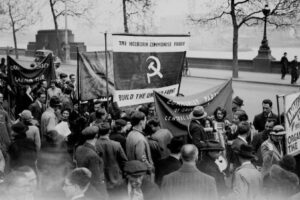
On May Day this year (2026), the Camden Trades Council initiated a 9 days commemoration of the 1926 General Strike in Britain. This is part of a national Trade Union mobilisation to celebrate the 100th anniversary of the General Strike. In the UK, Trades Councils are committees composed of delegates from the different trade unions in existence in particular local or regional workplaces. There are about 123 different unions in the country, and around 170 Trades Councils today. Most of the latter are affiliated to the Single Trade Union Congress (TUC). The earliest Trades Councils were formed in the 1840s and 50s, mostly in the working-class areas, railways, mines, industries, workshops, offices, etc. St Pancras Trades Council delegates outside 67 Camden Road, Camden Town 1926 (gratitude to George Binette) – https://www.camdennewjournal.co.uk/article/general-strike-flashpoint The image above shows the locale of the 1926 Camden Trades Council in London. The Council was formed in 1907 under the name of Saint Pancras Trades Council. In 1926, it became one of the main coordinating centres of the General Strike nationally. On the façade of its building at No. 67 Camden Road (London NW1) a commemorative plaque was placed this May Day. The General Strike Like most other Trades Councils in the rest of the country, the Saint Pancras Trades Council turned itself into a Strike Committee on 4 May 1926 and adopted the name of The Saint Pancras Council of Action, (SPCA). The main sectors on strike were the miners who were already locked out before the start of the General Strike. In their support, the TUC called out the railway workers, dockers, iron and steel workers, the building trades, electricity and gas workers, and more. The number of workers on strike was near 2 million. Councils of Action were created by the Trades Councils (and others) throughout the country, to unify the strike, assure vital transport, help deliver food and goods – and most of all, to spread the Strike News. In Camden Road, the SPCA acquired a printing press and exceptionally well organised distribution methods. Its “Saint Pancras Strike Bulletin” reported and organised against the Tory government’s use of ‘volunteers’ (scabs) to drive buses and trams; and against the repeated police forays against the printing press. It took only a few days for the SPCA to widen the scope of its actions. It established a Women’s Group. It coordinated the huge strategic hub of railway workers, all on strike, across the three major railway stations of Euston, St Pancras and Kings Cross. The National Union of Railwaymen (NUR) recruited 200 new members in a few days. As we have seen, the Trades Councils are the local organs of the Trade Union Congress(TUC); but during the Strike, the TUC itself did not become involved. It published its own paper The British Workers which tended to advise strikers on how to play football. The TUC instructed the SPCA to stop printing, or to print only the central TUC documents. The SPAC did not agree at all with this. On 4 May it started publishing the St Pancras Strike Bulletin. The Bulletin coordinated strikers between industries, published strike updates, informed on strike action, on picketing and on meetings. The most conscious workers were Communists like Emile Burns, Frank Jackson and Kay Beauchamp. They started publishing The Bulletin against TUC instructions, and went on doing so until 12 May, when the strike ended after 9 days. When the strike was over, the SPCA which had done so much for the Strike was expelled from the TUC. The government used police raids to attack militant centres like the one in Camden. The capitalist class mobilised the British army under the government’s emergency powers to protect strike breakers. Soldiers would parade in full kit and go around in armoured cars. Churchill was more determined than Baldwin in the use of aggressive tactics. The employers’ class fought to have the Action Committees disbanded, the printing machines destroyed and the Strike centres shut down. The government took care to suppress news reporting its actions. Leading workers were arrested and charged with sedition. The Councils of Action Created on 3 May 1926, the Saint Pancras Council of Action met daily and kept itself in almost permanent session from 4-12 May. Communist militants encouraged workers to form new Councils of Action everywhere. A typical Council of Action involved representatives from each Trade Union or strike group; it included constituency Labour parties and Women’s organisations. The National Strike committee gave reports to the Councils of Action. The Camden Trades Council recently reported: “The idea of Councils of Action was developed in 1920 when the TUC and the Labour Party NEC formed a ‘Council of Action’ with the aim of preventing the British government from declaring war on Soviet Russia, or supplying troops and munitions to [..] ‘White Russian’ forces.”[1] One hundred years since the General Strike is a very short time in history. The British workers did not mobilise just for improvements, but for power as well. Because their inspiration had come from the 1917 Bolshevik Revolution, the Councils of Action started in 1920 and not 1926. The authority of the USSR was immense in the working class in those days. The Councils of Action were pro-Communist. They opposed the pro-imperialist Whites whom the British capitalist class was arming[2] against the USSR. The Anglo-Russian Joint Advisory Council. For Leon Trotsky who wrote abundantly on the General Strike, the British workers were not moved just by anger at the capitalist class. Inspired by the Russian Revolution, they acted as a class trying to take the power away from the capitalist class. Trotsky defined the General Strike as revolutionary. The TUC leadership did everything to impose its central and paralysing control on the striking workers. It encouraged passivity. Its behaviour aimed at stopping workers from communicating, publishing, picketing, winning the population. From his United Opposition platform in Moscow and Leningrad, Trotsky decried the then TUC President, Albert A Purcell, a Labour MP in Coventry and a
VIVA THE BRITISH CHAPTER OF THE ANTI-FASCIST INTERNATIONAL OF VENEZUELA
Viva its Foundation Programme! The Posadists Today value the Anti-Fascist International (AFI) and wish to contribute to its UK Chapter with Marxist ideas and militancy. Below the presentation, the reader will find extracts from the Foundation Document of the Anti-Fascist International (AFI) created in 2024 in Caracas. Then the reader will find the Foundation Document of the British Chapter of the AFI. Its programme responds to today’s need for “a real, anti-imperialist anti-war movement that mobilises workers to refuse to participate in the imperialist war machine, which they have the power and duty to obstruct”. Presentation: In April 2007, the Posadists heard Hugo Chavez’ speech on Alo Presidente, in praise of Trotsky. He named The Transitional Programme and The Permanent Revolution, and advised the public to read Trotsky ([1]). The Trotskyist Posadists felt duty bound to support this revolutionary leadership, as well as to contribute the relevant programmatic ideas to help it build a Workers State. Back in Nov 2009, Hugo Chavez had called for the construction of ‘The Fifth International’. An international meeting was initially called and then cancelled. Caracas 2022: A militia prepares to fight a guarimba. The participants are ordinary people who drill for the militia regularly after work. In November 2022, the Trotskyist-Posadists attended the Caracas FILVEN (Bookfair) with a recently published Spanish Edition of J Posadas’ book: “Sobre la Necesidad de una Nueva Internacional”. (On the Necessity for a New International). The book sold out and was placed in Venezuelan libraries. With the formation of the First Anti-Fascist International (AFI) in 2024 in Caracas, the Posadists Today decided to support it. Their aim is to learn from the AFI’s experience, to help with the building the UK Chapter, and to contribute Posadas’ ideas on how to pass from the Revolutionary State to the Workers State. In the UK, and in the wake of the continuing Labour debacle in the UK, the mass anti-capitalist Party of the future is already staring world war in the face. The Starmer government aligns with that of the European Nato countries, in defence of Nazi-fascist Urkaine and for “war on Russia”. This situation demands immediate anti-Nazi and anti-war organisation, internationalism and proletarian co-ordination. The Civic Military Union for power created in Venezuela does not mechanically translate into a direct example for Britain. This said, the Anti-Fascist International (AFI) and its British Chapter are key resources of knowledge and of experience for the British workers to learn from as well as the whole of humanity. Extracts from the Caracas Foundation Document: The AFI (Caracas) announces its Action Plan on 11 Jan 2025. Here are the extracts from the Caracas Foundation Document: “The Anti-Fascist International (AFI) of the Bolivarian Republic of Venezuela was founded in Caracas late 2024 with the participation of 76 countries. The International Anti-Fascist Promotion Committee which it created on 27-28 November 2024 helped set up the International Anti-Fascist World Festival for a New World in January 2025 with 2,000 delegates from 125 countries in attendance. “The Promotion Committee is creating world structures of anti-fascist coordination. The AFI is a global initiative aiming to combat fascism, neo-fascism, Zionism and the world imperialist aggression spearheaded by the USA. “The AFI commits to founding work teams in the 76 countries that took part in its World Meeting in November 2024. It views itself as an organic platform “to guarantee victory in the definitive battle against fascism, neo-fascism, Zionism and similar expressions”. “The AFI considers that the resurgence of these historical aberrations constitutes the greatest threat that the world faces today. We need to coordinate binding and supportive actions that penalize the practices of instigation to hatred, extremist fanaticism, xenophobia, misogyny, aporophobia (hatred of the poor), revenge, violence, death and all the forms of annihilation of differences that are pursued by fascism.” End. Foundation Document of the AFI’s British Chapter: The British Chapter demonstrates against war on Iran at US embassy, 8 March 2026 TOWARDS THE CONSTRUCTION OF A BROAD ANTI-FASCIST, ANTI-IMPERIALIST AND ANTI-WAR FRONT IN BRITAIN « The British Chapter of the Anti-Fascist International is a coalition of groups and individuals standing against fascism, imperialism and the barbarity of war. With the resurgence of fascist forces internationally and the lurch towards another world war, our tasks are urgent! We are committed to working in a democratic manner, with open platforms to build maximum participation and unity. We call on all individuals and organisations active against war, fascism and imperialism to join with us. The future of humanity needs you! The Organising Committee of the British Chapter of the Antifascist International, following the Antifascist Declaration of Caracas, recognises the situation in Britain and the world today: Imperialism, the subjugation and exploitation of oppressed nations by oppressor monopoly-capitalist states, is the dominant force in the world today. Imperialism is opposed both byoppressed nations that want to use their resources and labour for their own interests and the working classes who want to exercise their own economic and political demands in a popular, participatory and proactive democracy. Economic crises of imperialism lead to political and military crises, during which imperialist powers seek to retain control over oppressed nations, gain access to the resources, cheaplabour-power, and new markets in independent nations, and strengthen their grip over the working class at home. The imperialist nations (led by Britain, the USA, Germany, France and others organised in Nato) and their junior partners use the most brutal and inhumane methods to oppress people around the world. They use sanctions, unjust trade relations, and debt burdens to keep oppressed nations underdeveloped and impoverished. If their domination is threatened they resort to invasion, coups, and occupation, and all manner of terrorist methods to suppress resistance, including concentration camps, torture, assassinations, and the deliberate targeting of civilians and civilian infrastructure. As the economic crisis deepens, the imperialists are increasingly resorting to fascistic methods to safeguard their interests. InBritain they use political policing to suppress speech, are trying to remove jury trials for significant court cases, and criminalising any real opposition by legally branding it
VENEZUELA 2026: NO TO THE CRIMINAL AGGRESSION OF US IMPERIALISM!
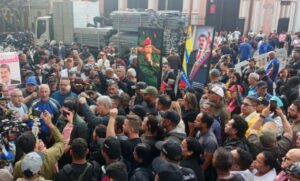
faced with the unacceptable military agression and capture of the legally elected president of Venezuela, Nicolas Maduro and his partner We publish below a recent article on the ‘Venezuela Infos’ blog. This article reports on Saturday’s facts (3 January 2026) and shows the situation in the country. It reports on the indignation and the resistance of the Venezuelan population, the unity of the armed forces, the statements by the National Defence Council and those by the Vice-President of the Bolivarian Republic, Delcy Rodriguez. In the early morning of January 3, 2026, US troops launched a criminal incursion into Venezuelan territory. They bombed various strategic points in the country, damaged infrastructure, murdered military and civilians. They kidnapped the President of the Bolivarian Republic of Venezuela, Nicolás Maduro Moros, and his wife, Cilia Flores. This operation is the most serious, and the most violent attack perpetrated by the United States against a country in the Americas since the invasion of Grenada (1983) and Panama (1989). There are already solidarity mobilisations in most capitalist countries in support of Venezuela*. These must be extended and coordinated, particularly in the working-class parties and movements. They must defend the engagement of Venezuela’s revolutionary process in the construction of a socialist society based on real democracy and its Government of the Municipalities. This commitment is the real political target of the Trump administration’s imperialist aggression – and not any fallacious pretext of so-called drug trafficking. Posadists Today, 5.1.26 &.&.&.& Since September 2025, under the pretext of fighting drug trafficking, Donald Trump’s administration has launched a new offensive against Venezuela, which has gone from economic pressure and attacks on ships suspected of transporting drugs, to the diversion of oil tankers and the largest naval and air blockade ever seen; the aim being to overthrow the government of Nicolás Maduro and instal a puppet government that surrenders the country’s oil, water and other resources to imperialism. The offensive against Venezuela comes in the context of Donald Trump’s launch of his corollary to the Monroe Doctrine: With the global media domination of the United States, to reassert imperial hegemony weakened at world level by the geopolitical changes. An attempt is made to show this criminal operation as enjoying the support of the Venezuelan people. But only a few isolated and marginal demonstrations in Trump’s support have been observed in some cities in Europe and Latin America. With none in Venezuela where no influential political force has managed to speak in favour of the kidnapping of the president. In the world, demonstrators have taken to the streets everywhere to repudiate this barbarism. There were thousands in Paris. It remains that an operation of such psychological terror does create the ideal setting for the “regime change” long intended by Trump: A Nicolás Maduro previously portrayed by media as a “narco-dictator”, can be dragged before a New York court in handcuffs and a prisoner’s outfit as if it were a new trial against El Chapo Guzmán (a former Mexican ‘drug-lord’). This lowering of the president and leader of the revolutionary process to the rank of ordinary criminal is necessary for imperialism to get on with the promise of a “peaceful transition” between the current interim president of the Republic, Delcy Rodríguez, and the far-right oligarch María Corina Machado or Edmundo González, the former opposition candidate. This so-called “regime change” operation is nothing but an attempt to impose a “puppet” leader who will hand the country’s natural resources over to the United States. The kidnapping of Maduro and his wife was undoubtedly made possible by mistakes in the Venezuelan intelligence and security services. There was a successful infiltration of the United States in the president’s close circle, but ‘regime change’ is still far from completed. The country shows this. The vast majority of Venezuela’s population moved quickly from the confusion and shock of the early morning hours, to indignation, courage and a fighting spirit; as in the aftermath of the 2002 United States’ coup d’état against President Chávez, with (already then) the support of a certain Maria Corina Machado, when thousands of people took to the streets to demand the safe return of their president and condemn the US military actions. The Armed Forces demonstrate their unity and loyalty to the people and their president. Regardless of the widespread narrative that Venezuela lives under a dictatorship that flouts civil liberties, the Bolivarian Revolution – initiated under the leadership of Hugo Chávez in 1998 and pursued today by Nicolás Maduro – deepens a socialism based on the direct democracy of the Communal self-governments. This democracy where 70% of the responsible positions are assumed by women, has forged between the people and the Bolivarian Armed Forces a unity that this January attack is not going break easily. It involves 5,336 municipalities and municipal circuits, supported by units of armed citizens deployed throughout the national territory. Beyond the state apparatus, this organisation stands as cornerstone and foundation to the only force, the popular force, that can put paid to the neo-colonial occupation. Accompanied by ministers, magistrates and military leaders, Delcy Rodríguez reiterated the decree of External State of Emergency that Maduro had signed, and handed it over to the president of the Supreme Court of Justice (TSJ), Caryslia Rodríguez. This decree creates a National Defence Council, bringing together representatives of the various branches of government. She also cited the Letter of Jamaica, a document written in 1815 where the liberator Simón Bolívar sets out the principles of independence of Latin American countries: “The veil has been torn. We saw the light and now they want to bring us back into the shadows. But our chains are broken. We are free and our enemies want to enslave us.” Delcy Rodríguez called on the population to stay calm to let the government continue the political project initiated 27 years ago. As she sees it, Nicolas Maduro always wanted dialogue with the United States but the response was always that of “violence and aggression”. “This government has wanted to maintain a constructive dialogue from the beginning. However, we are witnessing a
NATO: A MILITARY ALLIANCE OF AGGRESSION FROM ITS INCEPTION
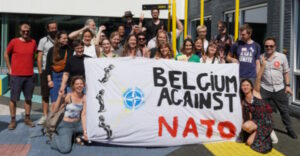
This article appeared as an editorial in the Special Edition of the Belgian journal “Alerte OTAN” for the Nato counter-summit of 21-22 June 2025 in The Hague. Edited by the “Comité Surveillance Otan”, this editorial is reproduced below in translation from the French, and followed by the Statement of the “Stop Militarization” Platform. The latter regroups some fifty Peace Associations and social movements who repudiate the militarist program that is being imposed by the Belgian ‘Arizona government’[1]. On 26 June 1945, the young United Nations solemnly adopted its Charter founded on the principle of the sovereign equality of all its members. The very first article proclaimed that, in their international relations, “the parties undertake (…) to refrain from the threat or use of force in any manner inconsistent with the purposes of the United Nations.” The United Nations Charter made explicit the obligation of member countries “to unite their forces to maintain peace and to take effective collective measures to prevent and remove the threats to peace.” Four years later, twelve countries including nine of the UN founders, the big imperialist powers of the time among them, formed a military coalition explicitly aimed against another UN co-founder, the USSR, which they dramatically declared to feel “afraid of”. What of joining the forces [of UN members] to maintain the peace? What of refraining from the threat of, or from the use of force? In 1950, the head of the US State Department declared: “One can only deal with the USSR is by creating situations of strength. That is the purpose of the arms program [for Western Europe].” From the Korean war to the war in Ukraine NATO’s creation was in fundamental contradiction with the spirit of the UN Charter, never mind the sophistry introduced in its statutes. Not only in March 1999 with the aggression against Yugoslavia, and not only in 2003 with its long occupation of Afghanistan, but from its very creation in 1949. By June 1950, NATO was already involved in the Korean War. Under American command, five NATO member states[2] including Belgium joined the international military force that landed in Korea. The Korean conflict was NATO’s first real test, even though this was taking place on the other side of the world, as Truman and other NATO leaders openly stated. Beyond the destruction of the USSR, NATO’s central objective was and remains to ensure the maintenance of “Western” hegemony over the world. In 1991, the Soviet Union dissolved itself, leading to the dissolution of the Warsaw Pact[3]. But NATO did not dissolve, despite the disappearance of its official ‘raison d’être’. On the contrary, it was from 1991 onwards, and freed from any counterweight, that it was able to show its true colours as the armed wing of imperialism. From war to war, as main actor (Yugoslavia, Afghanistan, Libya) or as a secondary actor (Iraq, Syria), NATO has inexorably moved towards the next stage: the final subjugation of Russia. Since the 1990s, the Alliance (NATO) had absorbed 16 new members, gradually moving closer to its target. In 2014, the United States and the EU crossed a fatal red line by shamelessly supporting a coup d’état in Kyiv [Ukraine] led by fascist paramilitary organizations, and providing NATO assistance to the Ukrainian’s regime war against the part of its population that had revolted against it. The direct Russian military intervention took place after 8 years of a horrific war that has been obscured here. The current war is the culmination of a long war of NATO on Russia, which has been going on since well before 2014. Three years after the outbreak of this open war of NATO against Russia, the hoped-for collapse of ‘the enemy’ has not occurred. And this in spite of the piling up of anti-Russian economic sanctions and the successive crossing of “red lines’. It is essential to clearly identify NATO’s responsibility in this war in Ukraine. Failure to do so traps us in the media narrative of an “unprovoked aggression” to which the only response is, of course, “the militarily defeat of the aggressor”, with any negotiation denounced as capitulation. Building a global front against the war that NATO prepares! At the Hague Summit, NATO wants to plunge us into World War III and impose its “rules” on the entire world. The genocide of the people of Gaza by the fascist state of Israel is only made possible by the complacency, complicity, incitement, and collaboration of NATO’s main leaders. The NATO Counter-Summit, which will be held simultaneously in the Netherlands and in all member countries of the Atlantic Alliance, can develop very important counter-power actions. A broad front against NATO and its wars is being built. Everywhere, the same demands are rising: Stop Militarization – No to the war economy – No to enriching the military-industrial complex – All GDP to be spent on the social and cultural progress of the people – Participatory and protagonist democracy to organize cooperation between the peoples of the world! NATO Surveillance Committee, 21.6.25 www.csotan.org l groups.google.com/g/alerte-otan – info@csotan.org – Feature image: mobilisation of Belgian organisations during the NATO counter-summit 21-22 June 2025. *&*&*&*&*&*&*&*&*&*&*&*&*&*&*&*&*&*&*&*&*& Declaration of the ‘Stop Militarisation’ Platform Weapons make the world more dangerous Stop the increase in military spending and the militarisation of our societies! The genocide in Gaza, the war in Ukraine, Congo, Sudan and all the many other armed conflicts put the international system under very strong pressure. War is a horror and the search for solutions is essential. The Belgian government is considering only one option: more weapons and more military spending (see the analysis of the peace movement that accompanies this manifesto). But history shows that this does not lead to peace, nor does it guarantee “security”. International security problems are rooted in socio-economic and environmental upheavals, looting and exploitation, or are the consequences of a lack of diplomacy and multilateral collective security mechanisms. Reducing security to a question of armament and military confrontation presents enormous dangers. The increasingly sustained militarization of
VENEZUELA, REBIRTH AND VICTORY OF THE COMMUNIST PARTY
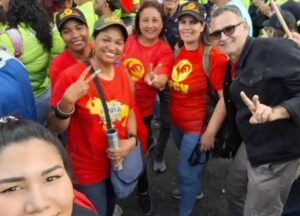
This article reviews the political history of the country; and shows how the renewed Communist Party has become a strong component of the Bolivarian Revolution. Posadists Today publish this article by Thierry Deronne[1] of Venezuela because it highlights the anti-imperialist maturity and resistance of the population of Venezuela. It also gives the lie to everything to be found in the bourgeois medias against the government of Nicolas Maduro. Parliamentary elections were held on 25 May 2025 to choose the 285 deputies of the National Assembly. The ruling United Socialist Party of Venezuela (PSUV) led by Nicolas Maduro won the parliamentary and regional elections by a landslide. It won 23 out of 24 state governor positions, whilst 16 municipalities lost to the PSUV in 2021 have now returned to it. In these May 2025 elections, the Communist Party of Venezuela’s new president, Henry Parra, implemented a strategy of support for the pro-Maduro ‘Gran Polo Patriotico’ which the PCV had left when it had been led by Oscar Figuera, after Chavez’ death. This electoral return of the PCV to the Gran Polo has contributed to the landslide in support of the PSUV in these 2025 elections. The political rectification of the Communist Party of Venezuela strengthens the Revolutionary State of Venezuela against the vitriolic attacks and renewed sanctions of US Imperialism. In 2024, the extreme-right-wing and pro-imperialist Orlando Moreno, had led the presidential campaign for Venezuela’s opposition coalition in the costal state of Delta Amacuro which borders the Essequibo. In these 2025 elections, Donald Trump and Marco Rubio threatened to register as ‘enemy’ anyone in the Essequibo daring to take part in the governorship elections, which were nevertheless won by Neil Jesús Villamizar Sánchez for the PSUV.[2] Posadists Today, published 23.2.2026 Start of the article written by Thierry Deronne: In recent years, activists from all over the world have regularly received statements signed “Venezuelan Communist Party” denouncing “the neoliberal regime of Maduro that persecutes the communists, represses the workers, crashes the wages and sows terror in popular circles the way fascism does“. With automatic solidarity and often in good faith, these activists pass on such messages without suspecting the true nature of the source or of the disinformation. Because not only does the real Venezuelan Communist Party support actively the Bolivarian revolution and regroups the vast majority of the activists, it has also just achieved historic results in the legislative elections of May 2025. A little bit of history… Founded in 1931, the PCV never became the spearhead of the proletariat. It developed in one of those vacant niches of the pluralistic façade gratifying to the Petro-Rentière oligarchy – something between Social Democracy and Christian Democracy. The opportunism of the PCV and with its eternal 1.5% electoral results had a way to annoy in their turn both Fidel Castro and Hugo Chávez. One of the problems of the pre-Chávez left resided in having been led by sons of the bourgeoisie. In a curious synthesis of colonialism and Marxism, the population was for them “an alienated mass to whom the political line must be handed down“. Some saw themselves as the new Fidel Castro or Che Guevara, but they left behind graveyards of martyrs, students, peasant families sacrificed in the struggle, and many disappointed hopes. Tired of the “big day” never arriving, the Venezuelan people finally turned to the one who knew how to listen, and talk to them – a certain Hugo Chávez. In the prison where his civic-military insurrection against government corruption had taken him, this brown-skinned soldier of modest origins understood that revolution would not come from these leftist minorities too far from the masses. The time had come to “dig up the dead mango-seed, and sow a new one” (1). In popular memory, his “Simon Bolivar National Project” brings new life to three anti-colonial roots: Bolivar, Rodriguez, Zamora[3]. The civil and military alliance of patriots speaks of the képi screwed on the peasant hat of Ezequiel Zamora, the general “of Tierra y Hombres Libres” (1817-1860). The philosopher Simon Rodriguez (1769-1854) asked of “the America freed from the Spanish yoke” (by his former student Simon Bolivar), “to invent, to be original, to no longer copy old Europe“. The political model in his mind was “Toparquia”, a communard government for each territory of the Republic[4]. The political prisoner Hugo Chávez comes out of his Yare prison in 1994. Amnestied in 1994, the Bolivarian soldier Hugo Chavez opts for the electoral road and begins a national tour. Everywhere, the crowds listen to him attentively. His strong popularity irritates the leadership of the Communist Party PCV. Later, Chávez will tell Ignacio Ramonet[5]: “When I got out of prison, the Secretary General of the Communist Party (PCV) [Oscar Figuera], said that ‘the presence of caudillo Chávez harms the popular movement’. The PCV leaders stopped me even participating in marches and demonstrations. They had understood nothing. All you could see in them was electoral recuperation and opportunism” (2). In 1999, the always-already excluded masses finally enter politics by having Chávez for President. The PCV cannot not digest that the “alienated people” should prefer the son of rural masters, but it still climbs on the Bolivarian bandwagon and sticks Chávez’ photos on its posters to increase its votes. It demands ministerial roles here, embassy ones there. Its secret hope is that this Bolivarian revolution parenthesis will close, and that it will be again the only party on the left. The breath of Chavist egalitarian life blows deeply over the political landscape, keeping the support of the electorate. In 2020, the Secretary General of the PCV, Oscar Figuera, declares suddenly that “21st century socialism is not a scientific doctrine” and that “Nicolas Maduro is not a Chavist but a neoliberal”. The party’s base criticises this change and expresses concern about the loss of activists to Chavism (3). Figuera turns a deaf ear, and to secure his position at the head of the party, he convenes a Congress limited to 80 “faithful” members instead of the usual 400 delegates. In 2023, a group of activists take this matter to
DOWN WITH THE WEAPONS, RAISE THE WAGES
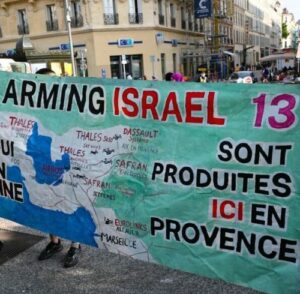
Interview with Cinzia Della Porta on the ‘Day of action against militarization and war’ in more than 20 Mediterranean ports, from Morocco to Turkey to Italy. This interview was held in Rome on 6.2.26 by ‘German Foreign Policy’. https://www.german-foreign-policy.com/fr/news/detail/10292 ROME (exclusive report) – This Friday, workers from more than 20 of the largest ports in the Mediterranean are organizing a day of action to protest against the EU’s militarization policy and against the use of ports for the supply of weapons in the war in Ukraine and Israel. They oppose “the transformation of the Mediterranean into a crossroads for the war economy,” explains Cinzia Della Porta in an interview with german-foreign-policy.com. Della Porta is a member of the executive committee of the Italian union Unione Sindacale di Base (USB),which participates in the organization of the day of action. The USB requires that the ports of the Mediterranean be “places of peace”. Della Porta points out that workers are always among the first to pay “the price of war” in the form of wage reductions for example, or restrictions on union rights, which are “direct consequences of the war economy”. In addition, the dockers who have to load the weapons become involuntary accomplices of wars which they reject. Della Porta pleads for “resistance to war to be associated with social struggles for wages, public services and workers’ rights”. This Friday, demonstrations are planned in particular by the USB and the unions Enedep (Greece), Liman-İş(Turkey) and ODT (Morocco). Actions and strikes are planned from Tangier to Genoa, Palermo and Trieste to Piraeus, Antalya and Mersin, as well as on the Atlantic coast, for example in Bilbao. The demonstrations include the ports used for arms deliveries, but used also for wage and pension reductions for the benefit of financing war, as well as European Union (EU) armament plans, including the militarization of ports and other strategic infrastructure in Europe. According to the USB, rallies are also planned in Hamburg and Bremen. german-foreign-policy.com: On Friday, a day of joint action will take place in more than 20 Mediterranean ports. What exactly is it? Cinzia Della Porta: Friday’s coordinated action aims to combat the increasing militarization of ports and logistics, the use of civilian infrastructure for military purposes and the transforming of the Mediterranean into a crossroads for the war economy. Our message is clear: ports must not be used to load, unload or even simply transport weapons intended for war, massacres or occupation. Workers from several Mediterranean countries, including Italy, Spain, France, Greece and other countries in Southern Europe and North Africa, are participating in this action. This reflects the common awareness of port and logistics workers that war is not an abstract geopolitical issue, but something that directly affects their workplace. This strike is part of a broader international mobilization against war and the war economy. german-foreign-policy.com: Workers in Italy and other Mediterranean countries have already protested against arms deliveries… Cinzia Della Porta: Yes, several concrete actions have been taken. In Italy, port and airport workers refused to load or tranship military goods such as weapons and explosives. In some cases, workers blocked port operations or stopped work when they discovered military transport. Thus, workers at Italian ports and airports have jointly stopped processing arms deliveries to Israel or Ukraine and have forced companies and authorities to divert or delay transport. Similar actions took place in other Mediterranean countries, where workers drew attention to the military nature of these deliveries through strikes, work stoppages and public demonstrations. For those who, in Germany or other countries, have not been informed by the mainstream media, here is what we did in Italy: There was the case of the “death ships”, the ships of the shipping companies ZIM and Bahri. In Genoa, USB workers monitored the cargo using “worker intelligence” and compared route and content data. When a ship of the Israeli shipping company ZIM docked, the dockers went on strike or blocked the doors with pickets. There was then a case at the airport of Pisa with weapons destined for Ukraine. USB workers refused to touch a plane at the civil airport that was loaded with boxes filled with weapons and ammunition, disguised as “humanitarian aid”. The workers saw the containers, documented that they contained weapons and not food or medicine, and called out this situation. Finally, there was also administrative sabotage. In some cases, the refusal to provide technical services – for example by tugboats or moorings – forced ships carrying arms cargoes to stay in port for several days, resulting in huge economic losses for businesses and sending a political signal to governments. These actions were not purely symbolic. They directly disrupted the logistics of war and unmasked what governments are trying to hide from the public. german-foreign-policy.com: Why should workers fight against militarisation and war? Cinzia Della Porta: Workers are the first to pay the price of war. Militarization leads to reductions in wages, social benefits, health care, education and public services, while huge resources are diverted to weapons and military spending. Inflation, precarious employment and deteriorating working conditions are direct consequences of the war economy. At the same time, workers are often forced, by their work, to become involuntary accomplices of war. Opposing militarization is therefore both material and ethical. Workers have a unique power: by stopping production and logistics, they can disrupt the war machine at its root. War is not an isolated event, but the only way for the capitalist system to survive a serious crisis. Take the example of the redistribution of wealth: the Italian government increases military spending to 2% of gross domestic product, or more than 100 million euros per day. This money is taken directly from collective agreements, the national health system and education. Militarization is in reality an economic manoeuvre of the ruling class against the poor. Militarization also leads to authoritarianism and oppression. The war economy requires “discipline”. This means stricter laws on strikes, precarious working conditions and the repression of union opposition. As a class union, the USB combines the struggle for workers’ rights with the fight against war. Since February
PRESENTATION OF J. POSADAS’ BOOK “FROM THE THIRD WORLD WAR TO THE END OF CAPITALISM”
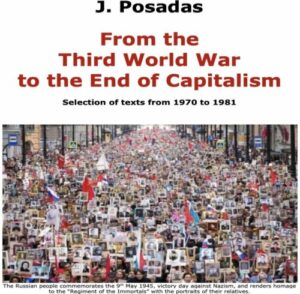
The title of this book is from the Editorial Board of the International Scientific, Cultural and Political Editions. It was published in November 2022 on the occasion of the 18th International Bookfair in Caracas, the FILVEN. Here goes: From the Third World War to the End of Capitalism J POSADAS PRESENTATION The book contains a selection of J Posadas’ texts on the fundamental question of the inevitability of war on the part of the capitalist regime – and consequently the inevitability of a third world war. It is vital therefore for humanity to put an end to the capitalist regime. The selected documents originate from multiple conferences and meetings that J Posadas held from 1970 until the year of his death in 1981. Some texts have already been published in the International Scientific Cultural and Political Editions (ISCPEs) in books like: “The Soviet Union”, “Workers’ State and Socialist Society”, “The Crisis of Capitalism, War and Socialism”. We publish also Leon Trotsky’s “The USSR in War”, dated 25 September 1939. That year, the Second World War had started on 1 September, and on that day, Hitler had invaded Poland from the West. It was only later, and in defence of the USSR, that the Soviet army entered Poland from the East, on 17 September. As Trotsky wrote The USSR in War eight days after the Soviet entry in Poland, his reference to “the occupied territories” is about Poland, and not about Finland. There, the USSR entered on 30 November 1939, 3 months after Trotsky’s article. Trotsky was to look back on the subject of Finland however, in April 1940, in his text “Balance Sheet of the Finnish Events”. It was only four months later that he was assassinated in Mexico. In his text The USSR in War, Trotsky expressed his conviction that, with the Second World War, the revolution would expand again, consolidate the Soviet Workers State and eliminate the factors that had given cause and justification to the rise of bureaucracy in the USSR. Here, Trotsky demonstrated not only his complete confidence in the role of the proletariat as the class that can lead the transition from bourgeois society to socialism, but the impossibility for the bureaucracy to transform itself into a class. Murdered in August 1940, Trotsky did not see the outcome of the war; but all his analyses and previsions have been amply verified: the world revolution did expand, and the power of the bureaucracy was weakened as a result. This did not bring the end of the capitalist system, but the class struggle brought in new relations of world forces favourable to socialism, impairing the relations in the capitalist camp. This was analysed by J Posadas when he showed how the Second World War had precipitated the rise of new Workers States and Revolutionary States. With this publication, our aim is to contribute to understand and intervene in the current revolutionary processes. In particular, we aim at intervening in the context of the on-going war in Ukraine. For it is not a war between two countries. It is not the war Russia vs Ukraine. It is the war NATO vs Russia, in a process that concerns the masses of the whole world. This war did not start either with the Russian ‘Special Military Operation’ in Ukraine (SMO) on 22.2.2022. With the dissolution of the USSR now behind us, the SMO returns a deal of socialist hope to the historic process. Many factors led Russia to the extreme decision of the SMO in Ukraine. To profit from the crisis and enfeeblement consequent on the USSR’s dissolution, Nato embarked upon its sanguinary enlargement. This was marked by its wars of occupation and rapine: in Europe (Yugoslavia), the Middle East (Iraq, Syria, Afghanistan), in Africa (Libya). In the former Soviet Republics, Nato stimulated internal conflicts to press its “Nato frontiers” closer to Russia, in hope of suffocating it. Having effectively appropriated most of Ukraine, Nato has turned that country into a ‘special’ military base, to attack Russia from there and try to destroy it. Russia’s SMO in Ukraine is a legitimate response. It stands as a powerful warning that the end draws near for unpunished imperialist war. The SMO stands also as a call to the world’s peoples to trust in the possibility of a World Front to break the hegemony that imperialism can only maintain through NATO. There are no more “neutral” countries in Europe. Directly or indirectly, Finland, Sweden, Switzerland have joined the NATO military alliance. It matters today that one should discuss this clearly, and unite against NATO preparing for war on the scale of the world, with nuclear weapons’ use included. No nation stands outside this process. The masses of the world do not want to pay for the crisis of the capitalist system. They want no truck in its war preparations against Russia or China. In all the communist parties, the socialist parties, the progressive and revolutionary nationalist movements of the world, in all the movements for peace and the environmentalists, the need grows to discuss this in depth and unite globally. We salute all the initiatives to build an anti-war world front. Our Editorial participates in it with the publication of these important texts by J. Posadas and León Trotsky. ISCPE, Oct 2022. Updated Feb 2024 Who is J. Posadas? J. Posadas was born in Argentina in 1912 and died in Italy in 1981. He began his activities as a trade union leader in the footwear sector. He soon adopted Trotsky’s ideas and joined the Fourth International. He then developed as a writer, theorist, political leader and revolutionary organizer. In 1947 he organized the Fourth International Group (GCI) and started the newspaper Voz Proletaria in light of the birth of revolutionary nationalism with Peronism in Argentina. He wrote major works such as “Plan Quinquenal or Permanent Revolution” and “El Peronismo” 1963, and “From Nationalism to the Workers State” 1966. In 1962, J. Posadas created the Trotskyist-Posadist Fourth International with some of his fundamental texts: “The Construction of the Workers’ State and from the Workers State to Socialism”; “The role of the USSR in History”; “The Living
THE WORLD SITUATION AND THE PARTIAL REGENERATION OF THE WORKERS STATE
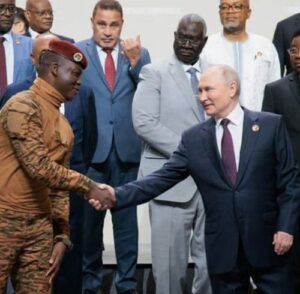
The text below is prologue to J. Posadas’ book titled (by the Editorial Board): “From the Revolution Betrayed to the Partial Regeneration of the Workers State”. The Third World War which the capitalist system is desperately preparing to launch against humanity, is at the heart of the concerns of all progressive sectors of global society. To confront this very critical situation, the need is urgent to develop the tools that lead not to “the end of history”, but to the end of this capitalist regime. To achieve this, one must assess fundamentally the function played by the Soviet Union since 1917, its triumph as the first Workers State and the true extent of its dislocation in 1992. About the latter, the Posadist Fourth International speaks of a partial disintegration. For one must also identify and observe what aspects belonging to the Soviet Workers State survived after 1992, and continue to live on in the Russia of today. Our International Scientific Cultural and Political Editions (ISCPE) published this book in its Spanish original in October 2025. As J. Posadas died in 1981, the book’s title is from the Editorial Board. The ISCPE have already published several books by J. Posadas on this question. These include “Workers State and Socialist Society” (1968) and “The Soviet Union: Historic Experience and Essential Program for the Construction of Socialism” (texts from 1968 to 1981). We are publishing this book separately. This is only its prologue. The book itself contains three chapters. These focus on the “Partial regeneration” in the USSR and the world Communist movement, as J Posadas saw that process emerging during and after World War II. That process stemmed from the way the Soviet masses fought, and the way they defeated the Nazis at Stalingrad. More generally, it stemmed from their unconditional defence of the Soviet Workers State. With the subsequent spread of revolutions in Eastern Europe, J. Posadas saw that, although still in the orbit of the Soviet apparatus, conditions were being created for a regeneration in the Soviet Union. A regeneration that did not exclude Political Revolution as a way to eliminate the bureaucracy. Following WW2, the new relations of power in the world became markedly favourable to revolution. To justify its role as ruling caste in the Soviet Workers State, and because its very existence depended upon the Soviet Workers State, the bureaucracy had to endorse the expansion of the world revolutionary process. J. Posadas defined this regeneration as “partial” however, because the bureaucratic support which it gave to the revolutionary processes did not aim at the expansion of the Workers States’ system. The policy of that caste remained a means to justify its usurpation of the political power. In the preface to the Edition of J Posadas’ book “The Soviet Union”, we said: [1] “Today, the bureaucracy has failed to restore capitalism; it has not transformed itself into a bourgeois class. The most it has managed is shake hands with small, mafia-like bourgeois sectors, with no possibility of capitalist development because they cannot compete with global capitalism. These sectors can only be transitory. The Yeltsin leadership that came to power in 1992 after Gorbachev’s dissolution of the USSR, did not last a single minute historically. Its intention to sell the Soviet riches to global capitalism and dismantle the USSR completely, was in direct contradiction with the vote of the Soviet masses in the 1990 referendum. In that referendum, 80% of the population of the Russian Federation took part [..]. The Russian masses fought in a way that limited imperialism’s ability to exploit the situation. This prompted Vladimir Putin to reinstate state control over strategic natural resources like oil, and to cut off their transfer to capitalism. The Putin leadership did not continue on the Yeltsin’s line. Today and globally speaking, Russia and China contribute to the development of Latin America, Asia, Africa, and the Middle East. They do it through economic and military accords that help people continue their revolutionary struggles, or continue to resist imperialism.” In 1992, imperialism rushed to declare victory over Communism. After the success of many “colour revolutions” that incorporated almost all of Europe into NATO, “neutral” nations included, these ‘colour revolutions’ began to lose momentum. The imperialist provocations against Russia were having doubtful effects on that country, but they were having devastating effects on the Nato countries implementing them. And what of the economy of Russia? Induced by imperialism and its satellites over time, there is a rise of economic problems in Russia. The Russian government remedies the situation by renationalising the strategic sectors of the economy, returning to planned production; it has improved living standards in the population, with better healthcare, education, wages, pensions[1]. But it is necessary to return to the first seven years of the USSR, to the basic Marxist principle according to which socialism is “the lower stage of communism”. The Soviet Union never embodied fully fledged socialism. The designation of Workers State comes precisely from this understanding, with the Workers State itself a transitory phase on the road to Socialism. Communism comes after that, world conditions allowing[1] (2) In the communist and socialist movements, the failure to uphold this view caused internal distortions, errors in their positions and policies of conciliation with the capitalist system. All this because they dropped the central anti-capitalist tenet of the struggle: the proletarian class must seize the power in order to carry out the social transformations. The need to understand Ukraine is fundamental today The current war in Ukraine is now central to the global confrontation between two antagonistic social systems – a confrontation that did not stop with the temporary dissolution of the Soviet Union. How to explain such a hatred of Russia in the Nato member states? Why do they put Russia and Putin at the head of their new “Axis of Evil”, along with China, Iran and North Korea? What must we say of the countries that Nato defines as “systemic enemies”? The capitalist countries pose as the “defenders of democracy” but they end up criminalising their political opponents; it is in fascist ways