On May Day this year (2026), the Camden Trades Council initiated a 9 days commemoration of the 1926 General Strike in Britain. This is part of a national Trade Union mobilisation to celebrate the 100th anniversary of the General Strike.
In the UK, Trades Councils are committees composed of delegates from the different trade unions in existence in particular local or regional workplaces. There are about 123 different unions in the country, and around 170 Trades Councils today. Most of the latter are affiliated to the Single Trade Union Congress (TUC).
The earliest Trades Councils were formed in the 1840s and 50s, mostly in the working-class areas, railways, mines, industries, workshops, offices, etc.
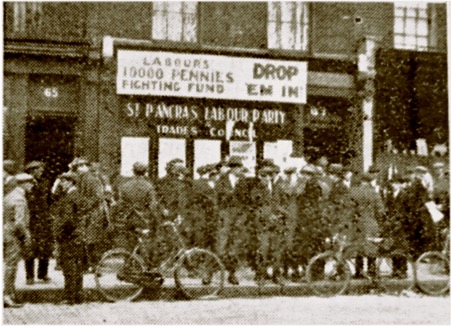 St Pancras Trades Council delegates outside 67 Camden Road, Camden Town 1926 (gratitude to George Binette) – https://www.camdennewjournal.co.uk/article/general-strike-flashpoint
The image above shows the locale of the 1926 Camden Trades Council in London. The Council was formed in 1907 under the name of Saint Pancras Trades Council. In 1926, it became one of the main coordinating centres of the General Strike nationally. On the façade of its building at No. 67 Camden Road (London NW1) a commemorative plaque was placed this May Day.
The General Strike
Like most other Trades Councils in the rest of the country, the Saint Pancras Trades Council turned itself into a Strike Committee on 4 May 1926 and adopted the name of The Saint Pancras Council of Action, (SPCA).
The main sectors on strike were the miners who were already locked out before the start of the General Strike. In their support, the TUC called out the railway workers, dockers, iron and steel workers, the building trades, electricity and gas workers, and more. The number of workers on strike was near 2 million.
Councils of Action were created by the Trades Councils (and others) throughout the country, to unify the strike, assure vital transport, help deliver food and goods – and most of all, to spread the Strike News. In Camden Road, the SPCA acquired a printing press and exceptionally well organised distribution methods. Its “Saint Pancras Strike Bulletin” reported and organised against the Tory government’s use of ‘volunteers’ (scabs) to drive buses and trams; and against the repeated police forays against the printing press.
It took only a few days for the SPCA to widen the scope of its actions. It established a Women’s Group. It coordinated the huge strategic hub of railway workers, all on strike, across the three major railway stations of Euston, St Pancras and Kings Cross. The National Union of Railwaymen (NUR) recruited 200 new members in a few days.
As we have seen, the Trades Councils are the local organs of the Trade Union Congress(TUC); but during the Strike, the TUC itself did not become involved. It published its own paper The British Workers which tended to advise strikers on how to play football. The TUC instructed the SPCA to stop printing, or to print only the central TUC documents.
The SPAC did not agree at all with this. On 4 May it started publishing the St Pancras Strike Bulletin. The Bulletin coordinated strikers between industries, published strike updates, informed on strike action, on picketing and on meetings. The most conscious workers were Communists like Emile Burns, Frank Jackson and Kay Beauchamp. They started publishing The Bulletin against TUC instructions, and went on doing so until 12 May, when the strike ended after 9 days. When the strike was over, the SPCA which had done so much for the Strike was expelled from the TUC.
The government used police raids to attack militant centres like the one in Camden. The capitalist class mobilised the British army under the government’s emergency powers to protect strike breakers. Soldiers would parade in full kit and go around in armoured cars. Churchill was more determined than Baldwin in the use of aggressive tactics. The employers’ class fought to have the Action Committees disbanded, the printing machines destroyed and the Strike centres shut down. The government took care to suppress news reporting its actions. Leading workers were arrested and charged with sedition.
The Councils of Action
Created on 3 May 1926, the Saint Pancras Council of Action met daily and kept itself in almost permanent session from 4-12 May. Communist militants encouraged workers to form new Councils of Action everywhere. A typical Council of Action involved representatives from each Trade Union or strike group; it included constituency Labour parties and Women’s organisations. The National Strike committee gave reports to the Councils of Action.
The Camden Trades Council recently reported: “The idea of Councils of Action was developed in 1920 when the TUC and the Labour Party NEC formed a ‘Council of Action’ with the aim of preventing the British government from declaring war on Soviet Russia, or supplying troops and munitions to [..] ‘White Russian’ forces.”[1]
One hundred years since the General Strike is a very short time in history. The British workers did not mobilise just for improvements, but for power as well. Because their inspiration had come from the 1917 Bolshevik Revolution, the Councils of Action started in 1920 and not 1926. The authority of the USSR was immense in the working class in those days. The Councils of Action were pro-Communist. They opposed the pro-imperialist Whites whom the British capitalist class was arming[2] against the USSR.
The Anglo-Russian Joint Advisory Council.
For Leon Trotsky who wrote abundantly on the General Strike, the British workers were not moved just by anger at the capitalist class. Inspired by the Russian Revolution, they acted as a class trying to take the power away from the capitalist class. Trotsky defined the General Strike as revolutionary.
The TUC leadership did everything to impose its central and paralysing control on the striking workers. It encouraged passivity. Its behaviour aimed at stopping workers from communicating, publishing, picketing, winning the population. From his United Opposition platform in Moscow and Leningrad, Trotsky decried the then TUC President, Albert A Purcell, a Labour MP in Coventry and a Communist Party (CPGB) founder. Purcell would speak ‘radical’ to get the trust of the militant workers, whilst he answered to right-wing leaders of the TUC general council like J H Thomas who were conniving to have the strike called off.
In 1925, Purcell had become key founder of the Anglo-Russian Joint Advisory Council. In contained representatives of the British TUC (like George Hicks) and representatives of the USSR’s All-Union Central Council of Trade Unions (like Mikhail Tomsky). The Council sought to draw the international Unions together, organise “common workers’ actions” against imperialist war and help to defend the USSR against any British intervention. When George Hicks became Chair of the TUC’s International Committee, this gave him a direct mandate in Anglo-Russian coordination.
Although the TUC’s intention to discourage the General Strike was no secret, the Soviet leadership of Stalin and Bukharin never criticised the skin-deep ‘radicalism’ of Purcell and Hicks. With the policy of Socialism in One Country, Stalin and Bukharin looked for a protective diplomacy in the Anglo-Russian Advisory Council, and not a means to increase the power of the working class at international level.
In early 1926, Stalin spoke of what he called a period of “capitalist stabilisation”, with the eventuality of a successful revolution “a long, long way off”. The Soviet leadership instructed the British Communist Party to call for “All Power to the TUC General Council”. In so doing, “the Third International (of the Bolsheviks) handed over the British revolutionary movement to the TUC bureaucracy” (World Socialist Web, based on Trotsky’s writings).
Trotsky condemned the Stalin and Bukharin leadership for having used “the prestige” of the Russian Revolution “to mask” the betrayal of Purcell and Hicks – essentially allowing these ‘left’ leaders to act as “the final line of defence for the British capitalist state”, (Socialistworld.net). In sum, the Soviet leadership had just handed over to these British ‘left’ leaders the keys to a policy that renounced proletarian internationalism and the replacement of Labour by a mass Communist Party.
Labour as the British mass Party was not inevitable
One of the lessons of the General Strike in Britain lies in that the policy of Socialism in One country helped remove from the fledging CPGB the opportunity to win Labour militants and start building itself as the mass Party.
The National Minority Movement (NMM) was a communist-led organisation which worked to influence the local strike actions. It set up some Councils of Action of itself, or it developed the authority to take control of some such Councils. The NMM had especially militant sections among the miners. They argued for a more revolutionary approach to the strike as opposed to the non-political and placid approach of the TUC. In Sheffield, the NMM produced news sheets at political level to counter the capitalist propaganda. Some NMM activists argued that the local committees should start taking control of essential services and municipal functions.
Even if the General Strike could not have been more successful in the end, a close contact between the Anglo-Russian Council and the British workers at the base could have remained a source of strength for future struggles. A conclusion from the General Strike is that many of the workers’ conquests were unnecessarily abandoned because the leaders chose to abandon them.
When the TUC called the Strike off on 12th May, the Strike Committees all over the country were still growing and the Unions were still gaining members. On May 13, the number of strikers in Saint Pancras was higher than on the previous day. Swathes of workers tried to continue the strike in defiance of the TUC. The miners remained on strike for another 7 months, and were left to fend alone.
The Miners’ leader A J Cook denounced not only the Tory Prime Minister Stanley Baldwin, but the Labour leader Ramsey MacDonald and NUR (Railway Union) General Secretary Jimmy Thomas.
As J Posadas analysed in the 1970s[3], the unnecessary loss represented by the policy of Socialism in One Country allowed for the Labour Party to continue as a mass Party absolutely unnecessarily. The abandonment of the aspects of dual power that had been won in the General Strike, granted to Labourism decades of political time and space during which it did nothing but attack workers and degenerate, along with the capitalist system itself.
Today in 2026, the capitalist class has no social support – in Britain or in the world. Its genocidal malevolence has reached proportions indicative of a regime from whose hands it is imperative to start out and take the power.
In its last Bulletin, the SPAC (then returned Trades Council status) declared:
“This is only the first skirmish. The fight is yet to come”.
[1] Extract from the leaflet “67 Camden Road”, distributed in London on May Day 2026 by the Camden Trades Council for the 100thAnniversary of the 1926 General Strike in Britain.
[2] In May 2020, the British bosses and capitalists tried to send the ship, the Jolly George, to Poland, with a cargo of weapons. The weapons were intended to be used by Poland against the USSR. At the East India dock, the workers learnt what was being sent and refused to load the ship. Workers created incidents with the Neptune ship (1 May 1920), with the Thames Barges (1920), and the Irish Munitions Strike (May 1920). During the period, there was a massive wave of industrial unrest with pro-Soviet workers leaders involved.
[3] The future of Labour is Communist, or it does not have a future (document on demand)
Top image: The British trade union leaders on the Anglo-Russian Committee 1926. Image: public domain.