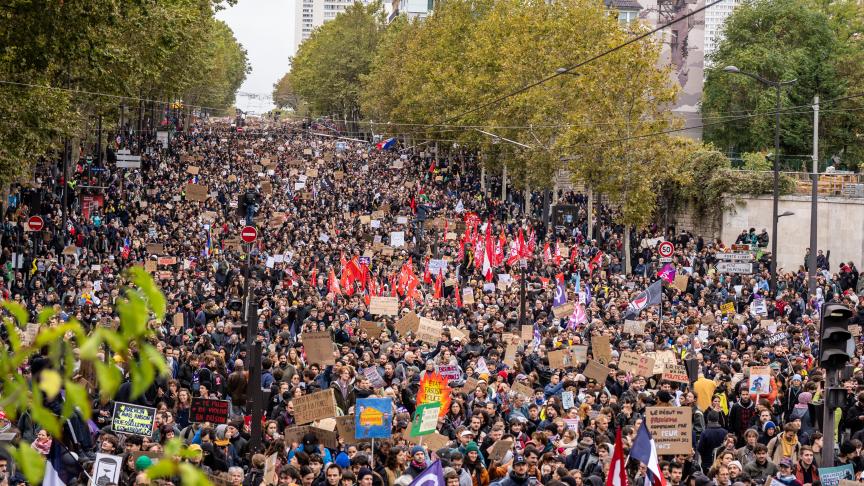
Ever since 26 September 2026, high school students have been taking to the streets, blocking access to classes against intolerable conditions for life and study. Problems by no means new. It is no coincidence that the revolt began in Seine-Saint-Denis, the poorest and most unequal municipality in the Paris region. Mobilizations started long years ago there, to protest the abandoned public services, and most notably, the drastic cuts in the national education system.
In 2024, a broad coalition—including trade unions, teachers, and students’ parents from primary, middle, and high schools—heightened the mobilizations through strikes. They used to demand “an emergency plan for the state’s schools” to stop chronic state underinvestment, educational and staff shortages, unsanitary conditions worsening in the school buildings and facilities. The support they received from local elected officials, community organizations and area residents led to no significant improvement .
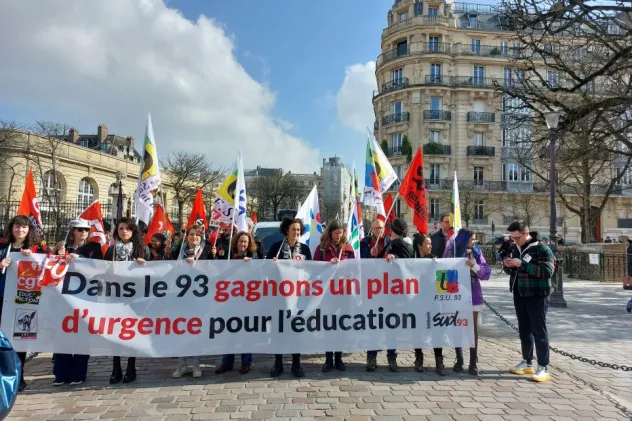
The anger of the high school students is justified, all the more for the official policy of showering obscene amounts on large corporations – 211 billion euros, according to a July 2025 Senate report[1] – instead of care for the public services and the concrete needs of the population. Seeing the number of failing companies and the redundancy plans announced, one wonders what good has been served by all the public subsidies. This exacerbates inequality. It inspires contempt in the young who deserve better than exclusion, precariousness, discrimination and a highly uncertain future.
The present anger wave comes after several months of extreme heat, when nothing was done in disadvantaged neighborhoods to help population prepare for climate change. Life became just unbearable in the homes. The new school-year started much as in previous years, overcrowded classrooms, un-replaced absent teachers, and then the « Parcoursup » digital platform[2], ostensibly designed to help students pursue chosen pathways but in reality a tool of social selection. Essential repairs undone, ceilings collapsing, insufficient winter-heating provision, toilets out of order, etc.
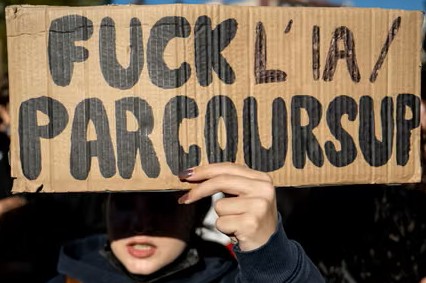
Students opposed to Parcourup.
The mobilization of the young people is driven also by the pressure of the political climate upon them. For we are told that war is at our doorstep and military spending must be increased. Following the abandonment of the Universal National Service (SNU), militarization is being introduced in schools. This is done through « Defense and Global Security » classes, both in the middle schools (collèges) and the high schools (lycées) – [13-15 and 15-18 year-olds]. This should develop in the young the notions of ‘defense’ and the Republican sentiment of belonging, the army being a way to social advancement and professional integration.
The wave of mobilizations has also to do with a coming budget more austerity-driven than the preceding ones. Projected government’s savings to the tune of 54 billion euros will slash social spending more than ever, worsening further the living conditions for the majority of the population already struggling with the rising costs of fuel, essential goods, gas and electricity.
NO to a life without a future
Young people are saying NO to policies offering no decent future. They express this in the streets, across the country, with cheerfulness and humor, carrying signs and slogans full of freshness and imagination. Contrary to the government’s predictions that the movement would run out of steam, the young people have succeeded—and week after week since 17 October—in rallying almost everyone to their cause: political parties, trade unions, parents, teachers, students and many other citizens. The « Yellow Vests » (Gilets Jaunes) included. The latter know well what sort of inhumane police violence is being used against the high school students; once again, they are in the fight against the high cost of living, the economic and social inequalities.
Police repression has been intense. And as is always the case when election campaigns draw near[3], agitators and rioters have been turning up. The aggression of the police and gendarmerie against the lycéens was so disproportionate that protestors engaged elsewhere felt in solidarity, like those fighting the « mega-basins » (massive reservoirs) at Sainte-Soline. Having themselves experienced unprecedented levels of repressive police violence, they easily drew the parallel.
The « New World Orchestra” is a group of young people who reinterpret the classical repertoire in their own way[4] protesting whilst playing their instruments. Even that orchestra was attacked by police with tear gas during its performance at the Place de la République in Paris; it seems that music does not necessarily soothe everyone’s temper!
Overall, many young people have been wounded, disfigured, or maimed by the use of military-grade weaponry[5], and 8,000 protestors have been brought before the courts.
We are being softened for war
War is in our streets therefore, meted out by a government and a system at the end of their tether. With the approach of the 2027 presidential and legislative elections, their loss of control fills them with fear. They have made “La France Insoumise” (LFI, Mélanchon) the scapegoat of all the « urban violence”, as they call it. But it was to downplay dissent that those in the media adopted this designation. They wanted to render invisible the demands of the young people invisible. Above all, they want to hide the high level of social consciousness in the youngsters of a society that cares nothing for them. Their consciousness was not communicated to them by LFI or any other political party. It came with the dire state of this world where the young find themselves. It comes from the mobilizations firing up everywhere against the reckless projects and archaic practices that exacerbate the climate crisis, destroy the environment, destroy biodiversity, deepen social inequality.
The violence of the repression seeks to instill fear. Some of the investigations carried out by independent press outlets —those not beholden to the pressures and dictates of multinational corporations and billionaires—have shed light on the way rioters and looters engaged in acts of destruction on 17 October were left entirely unmolested by police. That was when thousands of young people protesting in the streets were taken into police custody. They became subject to summary trials, or forced to endure inhumane conditions in prison.
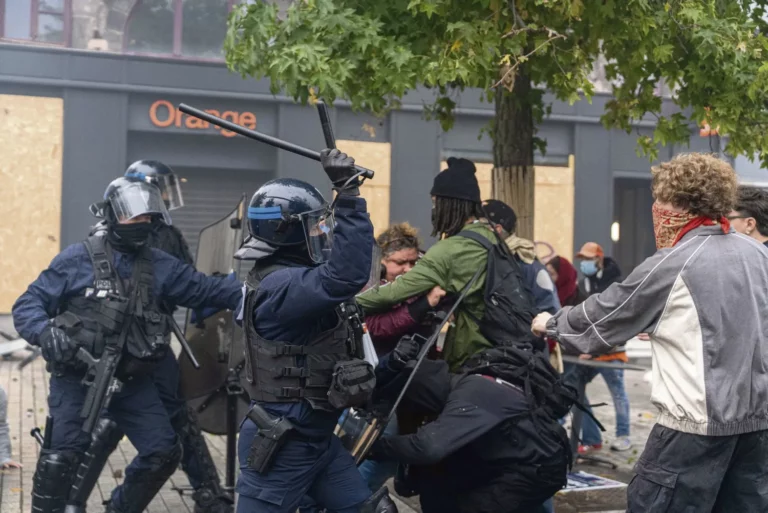
Police Violence
Who benefits from this situation? Certainly not the organizers or the participants in the protests, who can be seen marching calmly to express their wish for change. The repression benefits the far right, and its hope to impose an authoritarian regime and security-obsessed measures across every level of society. Far-right groups and neo-Nazi militias took to the streets in Nice, Montpellier, Rouen, Lyon and other major cities with total impunity. A simple look shows how they abuse and target those who disagree, those whose skin colour may not be white, those fighting for another society. The same applies to the attack in Trappes, which resulted in the death of a young Black man on October 23[6]. Supported by this government and the self-righteous bourgeoisie, those in the far right are normalizing racism and violence everywhere. And in doing so, they are preparing us for civil war.
What next for the social movement?
We are caught in a cycle of escalation where the democratic right to protest is being trampled. The government alters the protest routes at last minutes to limit the number of participants. It confines demonstrations to areas outside city centers “to prevent acts of violence and the looting of businesses”. It imposed curfews in major cities to thwart the mobilizations, and it arranged for telecommunications providers to block social media access. On 24 October, its officials had three coaches (out of 5) blocked at a toll plaza on a toll road, to stop 200 people from travelling to Rouen to protest against the National Rally (Rassemblement National) holding its congress in that city.
With the unanimous support of the right and the far-right, the Senate has just passed a [casseur-payeur] law – the « rioters-pay » law[7]. Any individual can become liable for damages to the tune of up to 10,000 euros, even if not personally responsible for destruction or damage in a public space. If the individual lacks the means to pay, the funds may be seized from any social welfare benefits they receive.
Other dangerous measures are in the works, such as house arrest. This « exceptional measure » started in a counter-terrorism context under the Internal Security Code. Now its present use means that a young person, even with no prior criminal record, can be placed under state surveillance.
Far from receding, the anger of the high school students keeps intensifying – seeing the lack of response to their demands and the escalating restrictions on their civil liberties. These measures fly in the face of constitutional principles. Student’s anger has now merged with broader social movement opposed to the government and its repressive, violent policies. On 4 October, 800,000 people came out in the streets of France, even in places not authorized![8] They kept the mobilization going on 31 October[9], with 500,000 protesters once again taking to the streets. They are now preparing to join the strike called for 5 November by the inter-union coalition.
The 5 November will be the day of actual strike action. In the present climate, it will be a significant event. The call comes from the five major trade union organizations, CGT, CFDT, FO, UNSA [autonomous unions], and FSU [Education], around demands for wage rises, improved public services, opposition to high living costs. The aim is to unite all the mobilized forces of the public sector with those in the private sector.
The presidential election of April 2027 is on everyone’s mind. This capitalist system exists solely to accumulate profits at the expense of the human beings and the natural world. It cannot foster a society where the young truly flourish. To keep its power, it uses all the means at its disposal to take away their freedom from those who do not keep on the path it wants to impose. It will resort to yet more repression and authoritarian measures. See the evidence here in the recent statements by Gérald Darmani, the Home Affairs Minister, who oversaw the crackdown at Sainte-Soline in 2023. There, he demanded the stripping of all civic rights from those responsible for looting, leaving the matter open as to who did the looting.
Over the coming six months, the left-wing parties face major responsibilities. They need to build a coalition around an anti-capitalist platform, to force a change of political direction and build a society of solidarity, ecology, equality and social justice. For the movement currently taking shape, the challenge is to keep up the pressure, impose other force relation conducive to finishing with this system.
Les Posadistes – October 31, 2026
Header photo: Mobilization in Paris, October 17, 2026
[1] Regarding this in France, Wikipedia says “this figure represents the total for a single year, specifically the year 2023. This figure includes employers’ social contribution exemptions, tax advantages and niche fiscal deductions. The direct state subsidies in 2023 were 7 billion euros”.
[2] Parcourup’ is a centralised online application platform used by students to apply for university. (Wikipedia).
[3] On April and May 2027, France will be voting to elect a new president. On 5 September 2026, France 24 cited opinion polls in France predicting a victory for Marine Le Pen of the far-right National Rally.
[4] The Orchestre du Nouveau Monde, ONM was founded in 2022. It is a Paris-based activist-led ensemble that blends classical music with social and climate justice movements (Wikipedia, drawn from the Guardian).
[5] On 7 Oct 2026, BBC reported that France halted use of stun grenades after a 15-year-old boy’s hand was torn off his body, near the Auguste Behal high school in Lille.
https://www.bbc.co.uk/news/articles/cqzjx7z2r4gko#:~:text=The%2015%2Dyear%2Dold%20boy’s%20hand%20was,the%20northern%20city%20near%20Lille.
[6] The family of Pengo Bossio Wangi denounced the racist attack where their son was killed in October in Trappes, near Paris. The family hopes this killing will lead to an awakening against racism in France.
https://www.facebook.com/africanews.channel/posts/the-family-of-pengo-bossio-wangi-the-young-black-man-killed-in-the-racist-attack/1127349069941782/
[7] This law needs to pass the lower chamber (National Assembly) before it can progress further. It is not yet active law.
[8] In Paris, the protest of 4 October 2026 demanded the French government should leave Nato, and stop supporting Ukraine.
[9] On 31 October 2026, the protest was against police violence and the cost of living. The journal Le Monde reported that this was the third weekend of French protests, with clashes erupting in some cities after the marches. The Interior Minister Nunez said the protests had been peaceful.